Power setup for Campervans
- Brenton Reilly
- Nov 19, 2023
- 7 min read
Should I get a DC-DC charger?
This post may contain affiliate links, meaning I receive a commission for purchases made through these links, at no extra cost to you.
As an electrician sometimes it can be overwhelming even for me when trying to decide the best power setup to implement in a camper van or caravan. There are many different solar charge controllers now available from the cheap basic ones to those which are more complex generally used in household systems.
With the use of lithium batteries DC-DC chargers are now becoming a popular method of charging batteries from either a vehicles alternator or from a combination of the alternator and solar panels. So is it worth the extra cost of purchasing the DC-DC charger or will the cheaper battery isolator do the job without problem?
The Typical setup for a basic battery isolator is shown below

Setup with dual source DC-DC charger for charging from both solar and the vehicle.

To consider your charging requirements it would be best to consider what you need to run (eg power rating of each appliance), time of day they will be running (when solar is available or at night time), and how long they will be running for.
Without having a mathematician to come up with the perfect differential equation for how your campervan will store and use power, you can only try and come up with a reasonable estimate and add something like a 30% safety margin so you’re not always draining your battery down to nothing.
For anyone trying to determine what size batteries and solar panels they will need I’ll outline a few steps below to try and work out your power requirements. Alternately, you can also jump straight to the section "Should you buy a DC-DC charger?".
Step 1. Batteries
One of the first considerations for your off grid power setup would be the type of batteries you will be using and how many of them you need. These would generally be either a deep cycle lead acid battery (Flooded or AGM) or lithium (LiFePO4).
The main criteria in deciding the battery type and size would generally be how much power you require (in watt hours (Wh) or amp hours (Ah)), how much power or current is needed to run your equipment during peak usage (Discharge rate of batteries in amps), as well as how long your will be running appliances and the budget you want to allow for this setup. If you are running equipment which will add up to 1kW (1000W) or more at any one time I would strongly suggest looking at the Lithium option. Lithium batteries also allow a greater depth of discharge without damaging the battery, which means they can run longer than the equivalent capacity lead acid battery.
How to work out your battery power requirements
To work out how much battery power you will need for your setup you can find out how many watts each piece of equipment is rated at and also work out how many hours you are likely to use the equipment each day. For example in the table below the details for a 40 watt camp fridge have been added with the compressor running for an estimated 8 hrs per day. This was added as 8hrs assuming there was enough solar in the day so that it wouldn’t drain the battery even with other equipment running. Other equipment generally does not run as long as a fridge so you could put the full length of time it will be running in this table.
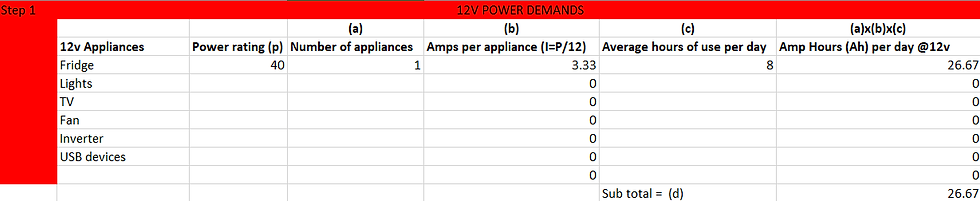
Table of power demands with the example of a 40W fridge.
You can also repeat this for appliances you are running via your inverter. If you just consider the power rating and calculate the current (amps) as above you won’t need to convert between voltages. There may also be a small amount of power loss at the inverter to consider as well.
If you add up the amp hours (in the final column) for all your main appliances this should give you an indication of the power requirement you need.
There are also two final considerations after this step and that is the recommended depth of discharge of the battery (the battery manufacturer or reseller will tell you this eg 80% DOD) and you also want to add a safety margin of something like 30%. This may vary depending on how essential the setup is.
If I have a 100Ah battery with an 80% DOD then I can only safely use 80Ah without damaging the batteries and reducing their life.
If I was just using the fridge in the table and nothing else I would have a total daily requirement of 26.67Ah. Adding a 30% margin to this 26.67 + 0.3x26.67 = a total requirement of 34.67Ah. My 100Ah battery with 80Ah of usable power should meet this requirement. If I was trying to run two of these size fridges it may run ok, however if I had three of this size appliance on this battery it would not fit within my safety margin. On a cloudy day without driving around this would most likely drain the battery completely.
Step 2. Solar
As the appliances you are running draw power out of the battery your solar panels and alternator can put power back into the battery and possibly provide excess power so that the battery can remain topped up throughout the day. Using the alternator for charging can also provide power when driving at night which is a good reason to use this charging method as well as solar.
To determine how much solar you require you will need to consider which appliances will be used in the daytime. If possible, on average between the solar and alternator you generally want to have enough to run appliances throughout the day and also have excess solar to fully charge the batteries before the sun goes down. There may be some periods where the battery voltage is going down for a short time, but in generally you don’t want to have your battery close to it’s minimum voltage for long periods throughout the day and night.
If you often have your battery cut out at low voltage you may have to add additional solar or batteries if possible, or you could also find ways to reduce use of equipment where possible. The amount of extra solar you can add to a small campervan may be limited so you could always add extra batteries or use fold out solar panels to add extra power when needed.
Step 3. Charger
Determine the best method of charging the batteries from the alternator and solar. Two of the main methods for doing this may include using both a battery isolator and solar charge controller or; using a DC-DC charger to charge the battery from both supplies. If you already have a solar charge controller or want a separate one you could also just use a DC-DC charger which works with the alternator supply only.
To determine the current rating required for your charger/chargers determine the current rating of each solar panel and multiply it by the amount of panels. See if you can also find the current rating for your vehicles alternator by looking it up online. If you are using a single DC-DC charger add the two values together, otherwise the combined current for the solar will give you an indication of the size of the solar charge controller and the alternator current will let you know the rating of the battery isolator or single source DC-DC charger. I’ll list 3 different options below starting with a simple setup with a battery isolator, a setup with a separate DC-DC charger and solar charge controller and a setup with a dual source DC-DC charger.
Option 1
Battery isolator and solar charge controller
1. Use a solar charge controller, either PWM (basic) or MPPT (more efficient)
2. Use a battery isolator for charging from the vehicle
Option 2
3. Use a solar charge controller, either PWM (basic) or MPPT (more efficient)
4. Use a single source DC-DC charger for charging from the vehicle
Option 3
1. Use a Dual source DC-DC charger to charge from both solar and the vehicle
Should you buy a DC-DC charger?
Using a battery isolator will stop your starting battery in your vehicle being drained when the engine isn’t running and allow for the auxiliary battery to be charged whilst driving. If you only have a basic setup such as using a deep cycle battery with a small solar panel, a battery isolator and basic solar charge controller (eg PWM) should be suitable.
The down side of using only a battery isolator is that there is not much in terms of intelligent multistage charging to protect the battery and increase it’s lifespan. For this reason DC-DC charge controllers are considered a better option when using lithium batteries as they are more vulnerable to overcharging. If your using lithium batteries or have a larger setup with more batteries and solar it would be worthwhile looking at using a DC-DC charger. Even though most lithium batteries may have a battery management system (BMS) and some form of balancing for cells, it is still considered a better option to use a charger which will vary throughout the charge cycle.
The cost of DC-DC chargers in the past was probably often more than the cost of batteries themselves, however now there are more reasonably priced solutions such as the one sold by Renogy below.
I’ll provide a list of basic equipment and links for each of the options above. These are affiliate links and I do get a small percentage for each sale.
I have recently started blogging and appreciate any feedback on the article, how easy it was to understand, any further questions or how it can be improved, and any other similar topics you want to know about. Please feel free to engage and provide any comments or suggestions. I also have an excel version of the table used to automatically calculate power demand for the batteries in step one if anyone would like to request a copy of this.
Parts list
Click items below to go to the product page
Option 1 - Basic battery isolator setup with AGM Battery
Solar
Renogy 12V 80W/100W/175W/200W Solar Panel Click here
Solar charge controller
Solar Charge Controller 30A Click here
Battery
Safetex 12V 135Ah AGM Deep Cycle Lead Acid SLA Battery Click here
Battery isolator
AULESSE Smart Dual Battery Isolator Click here
Option 2 - Slightly larger setup with separate DC-DC charger and lithium battery
Solar and solar charge controller
300W Solar Panel Kit Mono Caravan Camping Power with Solar Charge Controller Click here
DC-DC Charger
Renogy 12V 40A DC to DC Battery Charger 12V Battery Charger, Power Supplied by Alternator
Battery
Renogy 12V 100Ah Deep Cycle Lithium Iron Phosphate Battery Click here
Option 3 - Large solar and battery setup with dual source DC-DC charger and multiple lithium batteries
Solar
Renogy 200W Solar Panel Click here (x2 or 3)
DC-DC Charger
Renogy 12V 50A MPPT DC to DC Battery Charger Click here
Battery
12V Trolltek™ LiFePO4 Lithium Battery (200AH) Click here (x1 or more)


Comments